Remote Reading Water Meters: Pulse Output and Integrated Modules
Remote reading water meters move consumption data from the meter to a billing or management system without anyone walking a route. For utilities, sub-metering projects and industrial sites, the real question is not whether remote reading is worth it — it is which output or integrated module fits the reading infrastructure you already have, or plan to install.
Linyi Gaoxiang Water Meter Co., Ltd. (Gaoxiang Water Meter Co., Ltd.), founded in 2005, manufactures water meters and heat meters in Linyi, Shandong, China, and supplies markets including North America, Western Europe, Southeast Asia, South America and Africa. This page covers pulse output and integrated modules for remote transmission of consumption data — including the LXS15-300 with 1/10/100 liter per pulse — and what to confirm before ordering.
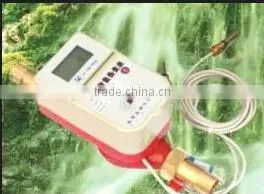
How Pulse Output Turns a Mechanical Meter into a Data Source
Most mechanical meters measure volume with a rotating element — a multi-jet impeller, or a Woltmann turbine in larger line sizes. A pulse unit on the register converts that rotation into a switching signal: each time a defined volume passes through the meter, the contact closes once. An external logger or concentrator counts those closures and converts them back into volume.
The key decision is how much volume one pulse represents. Finer values give better resolution but a faster switching rate; coarser values keep the signal calmer but hide small flows.
- 1 liter per pulse — finest resolution; suits low-flow monitoring and leak detection, but produces the highest pulse count.
- 10 liters per pulse — a middle setting for domestic and light commercial sub-metering.
- 100 liters per pulse — a lower count for large-diameter and industrial process lines, where small volumes are not the point of interest.
Our LXS15-300 pulse-output water meter is supplied with 1, 10 or 100 liter per pulse output. A pulse output is a pulse signal, not a data record — the meter does not interpret or store what it measures, so the accuracy of your recorded volume depends on your logger's input specification, filtering and counting. Confirm that match before ordering in volume.
Integrated Modules: When Meter and Reading Path Are One Unit
Some projects would rather not build the reading path themselves. For those, we offer categories in which the electronics that handle consumption data are integrated at the factory: remote reading meter, IC prepaid water meter, RF prepaid water meter and ultrasonic meter. The unit arrives as one assembly rather than a mechanical meter plus a field-fitted add-on.
Pulse retrofit or integrated module?
- Pulse output suits buyers who already run a data collection platform and want meters that feed into it while staying simple to service.
- Integrated module meters suit a standardised rollout across a new estate or utility area, where managing field electronics is the bigger cost.
- Mixed bills of materials are common: integrated units on domestic connections, pulse-output mechanical meters on bulk and industrial lines.
Because our range also covers LXSG-15E-50E large-diameter flange mechanical water meters, LXLC-250E Woltmann removable-element dry-type industrial water meters DN50-300mm, mechanical heat meters and water meter accessories, a single site can be sourced from one supplier. Send the meter positions, the reading platform and the pulse value you need, and we will confirm what we can supply against that brief.
AMR vs. AMI: What the Two Terms Mean for Your Specification
AMR and AMI are often used as if they were the same thing. The difference changes what you should order.
- AMR (automatic meter reading) is one-way: meters are read automatically instead of by hand. A pulse-output meter feeding a walk-by or drive-by collector is a classic AMR setup — faster readings, fewer transcription errors.
- AMI (advanced metering infrastructure) is two-way: the network collects consumption data and sends information back, such as changed reading frequency or status flags. AMI generally implies a fixed network, finer data granularity and integration with billing or operations software.
In short: AMR asks whether the meter can report volume; AMI asks how often, and whether the system can talk back. That decides whether a straightforward pulse output is enough, or whether the metering point must support a higher data cadence. For a fuller walk-through of what happens to readings after collection and how utilities use them, see our blog post on AMR, AMI and meter data.
Ordering, Testing and What to Send Us
All Gaoxiang water meters hold ISO4064 regulation approval certificates. The company is ISO9001:2008 certified and complies with the National Regulations for testing and metrology calibration.
- MOQ is 100 pcs for most products — 500 pcs for brass check valves, 5,000 pcs for plastic strainers.
- Prices are negotiable and depend on model, size, pulse value and quantity.
- Useful to send: meter positions and line sizes, required pulse value, your logger's input specification, target quantity and destination port.
Contact Mrs. Aileen Shao (Sales manager): +86-539-8121218, [email protected], Baishabu Town Industrial Park, Lanshan Dist., Linyi, Shandong, China. Sincerity first, quality foremost, service matters most.
Frequently asked questions
What does "1 liter per pulse" mean in practice?
Will your pulse-output meter work with my existing data collection system?
Do you supply meters with communication modules already fitted?
What is your MOQ, and can I mix models?
Which approvals do your meters carry?
Need remote reading water meter? Send your specification
Meter family, pipe size, estimated quantity, destination port — our sales team will quote. Standard MOQ is 100 pcs; prices are negotiable.
Prefer email? [email protected] · +86-539-8121218