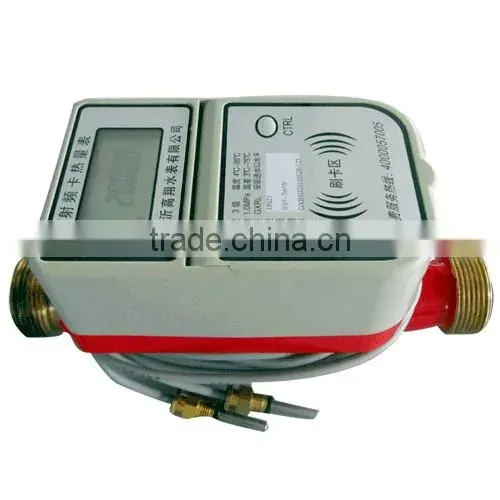
How prepaid meters work: card plus valve control
A prepaid water meter measures flow like a conventional meter, but it also stores credit and controls a valve. The user buys credit, the credit is written to a card, and the card transfers that credit to the meter. When the remaining balance reaches the configured limit, the valve closes. After recharge, the valve opens again. The exact valve behavior — and whether low-credit warnings or emergency credit are available — varies by model and must be confirmed with the sales team.
The card is the link between the utility or property office and the meter. In an IC card system, the card must be inserted into a slot so metal contacts can read and write data. In an RF card system, the user holds the card near a reader, and data moves without physical contact. Both approaches can support prepaid water metering, but they create different user experiences and maintenance profiles. See our prepaid water meter overview for related models.
IC contact card prepaid meters: pros, cons, best fit
An IC card prepaid water meter uses a contact card, sometimes called a smart card or chip card. The user inserts the card into the meter or a separate reader. The contact points exchange credit data and may record usage. This is a familiar, straightforward design for many property managers because the card must be physically handled, which can make recharge stations easier to control.
- Pros: Simple user routine; no RF pairing; card slot can be placed in a protected cabinet; suitable for indoor installations where dust and moisture are controlled.
- Cons: Contact points can wear, become dirty, or corrode; the slot needs cleaning; insertion takes longer than a tap; damaged cards may need replacement.
- Best fit: Indoor apartment buildings, staffed management offices, low-to-medium traffic, and projects where tenants are comfortable inserting a card.
If your site has a clean, dry meter room and a management office that can issue cards, an IC card prepaid water meter can be a practical choice. If the meter is outdoors or in a wet, dusty, or high-traffic area, review the enclosure and card handling with the manufacturer before specifying it.
RF contactless card prepaid meters: pros, cons, best fit
An RF card prepaid water meter uses a contactless card. The user taps or holds the card near the reader, and the meter reads or writes credit without a physical slot. Because there are no exposed contacts, RF cards are often easier for tenants and can reduce wear from repeated insertion. The reader and card still need to be matched to the meter, and RF performance can be affected by metal enclosures, nearby electronics, and installation position.
- Pros: Fast user interaction; fewer moving contact parts; better tolerance for damp or dirty environments when the enclosure is suitable; easier for high-traffic buildings.
- Cons: Card and reader costs may be higher; RF behavior must be checked on site; lost cards need replacement; some users may need training on tap distance and orientation.
- Best fit: Outdoor or semi-outdoor cabinets, humid or dusty utility rooms, dormitories, rental apartments, and commercial buildings where many users recharge frequently.
For projects with high tenant turnover or shared meter rooms, RF contactless cards can simplify daily operation. The trade-off is that you need a clear card management process and spare cards on hand. Card MOQ is 100 pcs.
Head-to-head comparison table
The table below summarizes general differences. Always confirm exact model features, valve behavior, and enclosure ratings with the manufacturer.
| Feature | IC contact card | RF contactless card |
|---|---|---|
| Data transfer | Card inserted into slot; metal contacts | Card tapped or held near reader |
| User speed | Slower; depends on insertion | Faster; depends on tap |
| Wear points | Contacts and slot | Reader and card electronics |
| Dirt and moisture | More sensitive at contact area | Generally more forgiving if enclosure suitable |
| Maintenance | Clean slot; inspect contacts | Check reader position; replace lost cards |
| Best environment | Indoor, clean, dry | Indoor or outdoor with suitable enclosure |
| Management | Card collection and recharge can be controlled | Convenient for high traffic |
| Valve control | Available on both | Available on both |
| MOQ cards | 100 pcs | 100 pcs |
Where the STS standard fits
STS, defined by IEC 62055, is a token-based payment metering standard. It is widely known in prepaid electricity, and it can also appear in water prepaid projects. STS defines how payment tokens are generated, encrypted, and carried, so a consumer can buy credit and enter a token into the meter. It is not the same as IC or RF card technology. An STS meter might use a keypad, a token printout, or a virtual token through a mobile channel. A card meter might use a proprietary card system that is not STS compliant.
If your tender or utility requires IEC 62055 STS, state that clearly in your specification. Ask the manufacturer whether the specific prepaid water meter model supports STS, how tokens are delivered, and what happens if a token is lost. Do not assume that an RF card meter is STS compliant just because it is prepaid. For more background on metering standards, see water meter standards explained.
Choosing for your project: tenant profile, climate, management capacity
Start with the tenant profile. If tenants are accustomed to inserting cards and the meter room is clean, IC cards may be sufficient. If tenants expect tap-and-go behavior, or if the site has many short-stay users, RF cards may reduce friction. If many tenants have limited dexterity or the card slot is hard to reach, contactless is often easier.
Next, look at climate and location. Contact cards need a protected slot. In humid, dusty, or outdoor cabinets, RF cards avoid exposed contacts, but the reader still needs a suitable enclosure and installation position. Then assess management capacity. Who sells credit? Who replaces lost cards? Who reads exception reports? A card system is only as good as its recharge and replacement workflow. For a broader selection framework, see how to choose a water meter.
Cards and replacement logistics
Cards are not a one-time purchase. Buildings lose cards, tenants move out, and damaged cards need replacement. Plan a spare-card stock of at least a small percentage of active units. Gaoxiang sells IC and RF cards with a MOQ of 100 pcs. The standard MOQ for most meters is also 100 pcs. Accessories have separate MOQs: brass check valves 500 pcs, plastic strainers 5,000 pcs, and IC/RF cards 100 pcs. Prices are negotiable, and lead time should be confirmed with the sales team.
Keep card serial numbers linked to meter IDs and tenant accounts. For RF cards, test tap distance after the meter is installed. For IC cards, inspect the slot for debris during routine maintenance. If you operate multiple buildings, standardize the card type and meter model where possible to simplify spare parts and staff training.
Send your prepaid meter specification to the manufacturer
If you are sourcing an IC card prepaid water meter or an RF card prepaid water meter, send your specification to Gaoxiang Water Meter. Include meter size, flow range, valve control requirement, card type, quantity, installation environment, and whether STS or IEC 62055 is required. The sales team can confirm model availability, MOQ, and lead time. Contact Mrs. Aileen Shao, Sales manager, at +86-539-8121218 or [email protected], or use the contact page. Address: Baishabu Town Industrial Park, Lanshan Dist., Linyi, Shandong, China.
Frequently asked questions
Can an IC card prepaid water meter be installed outdoors?
An IC contact card meter can be installed outdoors only if the meter and card slot are protected from rain, dust, and direct contact with water. In many outdoor or semi-outdoor cabinets, an RF contactless card meter is easier to manage because there is no exposed contact slot. Confirm the enclosure and installation conditions with the manufacturer before specifying.
What happens when prepaid credit reaches zero?
Both IC and RF card prepaid meters from Gaoxiang can use valve control. When credit reaches the configured limit, the valve can close to stop water flow. After the user recharges the card and transfers credit to the meter, the valve can reopen. Whether low-credit alarms or emergency credit are available varies by model, so confirm them in your specification.
Is STS the same as an RF card prepaid water meter?
No. STS is a token standard under IEC 62055, while RF is a contactless card communication method. An STS meter may use tokens, keypads, or virtual tokens, and it does not have to use RF cards. If your project requires STS, ask the manufacturer to confirm whether the specific model supports IEC 62055 and how tokens are delivered.
What is the MOQ for IC and RF cards?
The MOQ for Gaoxiang IC and RF cards is 100 pcs. The standard MOQ for most water meters is also 100 pcs. Prices are negotiable, and lead time should be confirmed with the sales team because it depends on model, quantity, and production schedule.