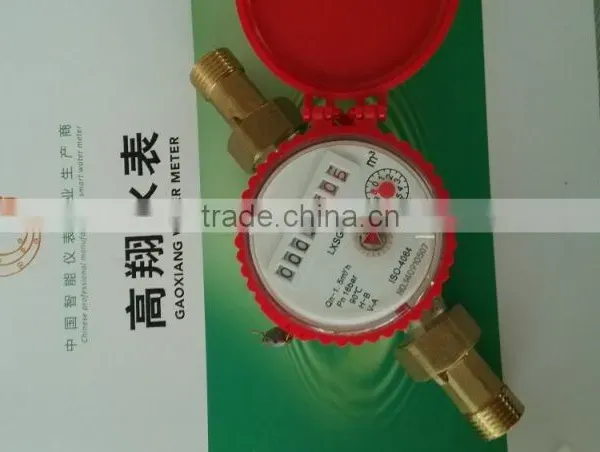
Velocity vs Volumetric: Two Measurement Principles
Most residential water meters fall into two broad groups: velocity meters and volumetric meters. A velocity meter, such as a single-jet, multi-jet, or Woltman design, measures the speed of water moving through the meter. The register converts that speed into volume based on the internal geometry. A rotary piston water meter takes a different path: it traps and releases a fixed volume of water, then counts each cycle.
That difference matters at low flow. Velocity meters infer volume from movement, so very small or intermittent draws can be harder to register accurately. Volumetric meters measure the volume directly with a moving piston or disc. Neither principle is universally better; the right choice depends on flow profile, water quality, pressure loss, and local metrology requirements.
| Aspect | Velocity meters | Rotary piston / volumetric meters |
|---|---|---|
| Measurement basis | Infers volume from flow speed | Counts fixed-volume chamber cycles |
| Low-flow behavior | Can miss very small draws depending on design and Q1 | Often strong at low flows when sized and installed correctly |
| Water quality sensitivity | Varies; particulates can affect moving parts | Generally more sensitive to sand, debris, and scale |
| Pressure loss | Varies by design and size | Can be higher at high flow rates |
| Typical fit | General residential, larger lines, high flows | Low-flow billing, clean water, compact residential services |
How the Rotary Piston Works in Plain Terms
A rotary piston water meter is a positive displacement meter. Inside the measuring chamber, a piston separates the inlet and outlet. (A related volumetric design, the nutating disc, uses a wobbling disc instead of a piston; both work on the positive-displacement principle.) Water entering the chamber pushes the piston. As it moves, it seals a known volume and pushes that volume toward the outlet. The piston then returns to its starting position for the next cycle.
Each cycle represents a fixed volume. The register counts cycles through a magnetic drive or mechanical linkage, so the displayed total reflects the number of chamber fills. Nutating disc meters work on the same principle with a disc that wobbles inside a chamber. Because the chamber is positive displacement, performance at very low flow is tied to the chamber design, clearances, and water quality, not just the pipe size.
Where Volumetric Wins: Low-Flow Accuracy and Billing Fairness
For property managers, utilities, and distributors, the main argument for a rotary piston water meter is low-flow accuracy. In apartment buildings, mixed-use properties, and small commercial sites, a large share of consumption can occur at low rates: dripping fixtures, overnight leakage, ice makers, humidifiers, and small tenant draws. A meter that performs well near its lower flow range can capture more of that volume and support fairer billing.
Billing fairness is not only about the meter. It also depends on correct sizing, installation, and testing. ISO 4064 defines key flow rates such as Q1, Q2, Q3, and Q4. Q1 is the lowest flow at which the meter must meet accuracy requirements, while Q3 is the permanent flow rate. When comparing a rotary piston water meter with a velocity meter, compare the full Q1 to Q4 range, not just the nominal size. See our guide to water meter testing and accuracy for more on test procedures.
Where Velocity Meters Win Instead
Velocity meters are often the better fit when flow is higher and more continuous, when pressure loss must stay low, or when the water is more likely to carry debris. Multi-jet meters are common in general residential service. Woltman and larger mechanical meters are used on mains, commercial lines, and industrial branch connections where flow rates are higher and the meter can be protected with strainers.
If your line has a wide flow range, high peak demand, or a history of sand and grit, a velocity meter may be more practical. A rotary piston water meter may still work, but it usually needs cleaner water and proper filtration. For larger lines, review our large-diameter water meter options or the broader mechanical water meter range before deciding.
Typical Applications for Rotary Piston Meters
Volumetric piston meters are commonly specified for residential direct billing, apartment units, small commercial spaces, and sub-branch metering hardware where low-flow accuracy matters. They can also be used in clean-water applications where the flow profile includes many small draws rather than one large continuous flow.
- Residential billing in single-family homes and apartment units
- Small commercial tenants such as cafes, offices, and workshops
- Sub-branch metering hardware for property managers and contractors
- Low-flow monitoring where leaks and trickle use affect cost allocation
- Prepaid or smart systems when paired with compatible register, valve, or communication components
Gaoxiang Water Meter manufactures piston/volumetric meters, including a Positive Displacement Water Meter Brass Body. Buyers can also combine meters with accessories such as brass connectors, couplings, check valves, strainers, and IC/RF cards depending on the system design.
What to Check When Specifying a Rotary Piston Water Meter
Before you request meter pricing, gather the details that affect model selection. Volumetric meters are sensitive to water quality and installation conditions, so the specification should be clear about the site.
- Flow range: Confirm minimum expected flow, normal flow, and peak flow. Match them to Q1, Q2, Q3, and Q4 in the model datasheet.
- Water quality: Sand, grit, rust, and scale can wear or jam a piston chamber. Ask about upstream strainers and maintenance access.
- Line size and connection: Check pipe size, thread or flange type, and whether a brass body or other housing is required.
- Register and output: Ask which register and output options a specific piston model supports — mechanical register, pulse output, IC/RF card prepaid, or smart electronic register. The existence of these product lines does not mean every configuration is available on every model. Pulse output can support AMR/AMI data collection when compatible.
- Pressure loss: Review pressure loss at expected peak flow, especially in low-pressure networks.
- Approvals: Verify local metrology and drinking-water requirements. Gaoxiang states all water meters hold ISO 4064 regulation approval certificates and the company is ISO 9001:2008 certified. Gaoxiang does not claim NSF certification, lead-free status, potable-water approval, or any US drinking-water approval for any model.
- Quantity and MOQ: Standard MOQ is 100 pcs for most meters and cards. Brass check valves have MOQ 500 pcs; plastic strainers have MOQ 5,000 pcs; IC/RF cards have MOQ 100 pcs. Prices are negotiable.
- Lead time: Confirm lead time with the sales team after the specification and quantity are clear.
Send Your Rotary Piston Water Meter Specification to Gaoxiang
If you are sourcing rotary piston water meters for distribution, contracting, utility, or property management use, send your specification to the manufacturer. Include line size, flow range, water quality notes, connection type, register or pulse requirement, quantity, and any approval needs.
Gaoxiang Water Meter has manufactured water meters since 2005 and operates as a manufacturer and trading company serving China, Western Europe, Southeast Asia, South America, North America, and Africa. Contact Mrs. Aileen Shao, Sales manager, at +86-539-8121218 or [email protected], or use the contact page to request a model recommendation and confirm MOQ and lead time.
Frequently asked questions
What is a rotary piston water meter used for?
A rotary piston water meter is used to measure water volume in low-flow applications, especially residential billing, apartment units, small commercial spaces, and sub-branch metering hardware. Because it is a positive displacement design, it traps a fixed volume of water in a chamber and counts each cycle. It is often chosen when small draws and leak detection matter more than high continuous flow.
Is a rotary piston water meter accurate at low flow?
Volumetric meters are generally known for strong low-flow performance because they measure volume directly instead of inferring it from flow speed. However, real accuracy depends on the model's Q1, Q2, Q3, and Q4 ratings, correct sizing, clean water, and proper installation. Always compare the datasheet against your minimum and normal flow rates before specifying a rotary piston water meter.
Rotary piston vs multi-jet: which is better?
Neither is universally better. A rotary piston water meter can be a good fit for low, intermittent flows and clean water. A multi-jet meter is often used for general residential service, higher flow rates, and applications where pressure loss and debris tolerance are priorities. Choose based on flow profile, water quality, maintenance plan, local approvals, and the total Q1 to Q4 range.
Do Gaoxiang rotary piston meters have NSF or US potable-water approval?
No. Gaoxiang does not claim NSF certification, lead-free status, potable-water approval, or any US drinking-water approval for any model. The company states that all water meters hold ISO 4064 regulation approval certificates and that it is ISO 9001:2008 certified. Buyers with US drinking-water approval requirements should verify local rules and request current documentation from the sales team.