What the Dial Type Means in a Mechanical Water Meter
A mechanical meter uses an impeller, piston, or rotary element to measure flow. The register holds the dial and counters. In a wet-dial meter, the register chamber is filled with the same water passing through the meter. The dial is read through a lens or cover, but the water surrounds the mechanical drive.
In a dry dial water meter, the register chamber is sealed. The measuring element still touches the water, but the dial stays dry. This matters because the register is where sediment, condensation, and temperature effects often show up first. Both designs can meet ISO 4064 accuracy requirements when built and tested correctly. The right choice depends on the application.
Dry Dial Water Meter: Pros, Cons, and Best Applications
A dry dial water meter uses a magnetic coupling to transfer movement from the water side to the sealed register. The dial, gears, and counters stay out of the water path.
- Pros: Clearer dial reading because the register is less likely to fog, stain, or collect sediment. Better register readability in dirty water because the register is sealed; the measuring chamber itself is still exposed to sand and sediment. Often preferred for hot water because the dial is not sitting in hot water.
- Cons: The magnetic coupling can be affected by strong external magnets if the meter lacks protection. Low-flow performance depends on the measuring element and magnetic drive design, so compare ISO 4064 Q1/Q2/Q3/Q4 data rather than assume.
- Best applications: Hot water systems, poor water quality, visible dial needs, and installations exposed to condensation or temporary flooding.
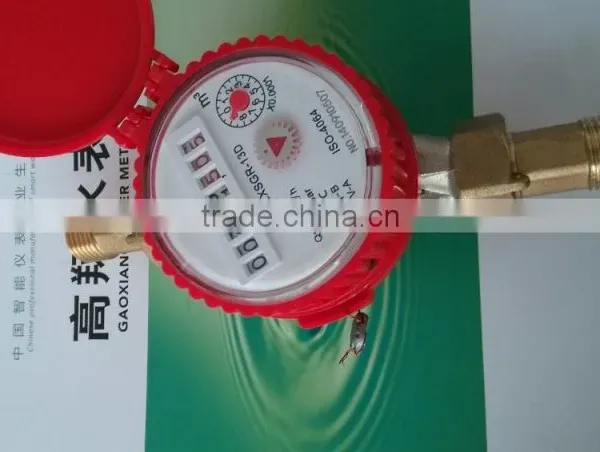
Gaoxiang's mechanical range includes a Hot Flow Meter Single Jet Dry Dial. For hot water, confirm temperature rating and materials with the supplier. See the hot water meter guide for more context.
Wet Dial Water Meter: Pros, Cons, and Best Applications
A wet-dial meter has a water-filled register chamber. The dial is read through a sealed lens or cover, but the drive and register area contact the water. This is a long-standing design for clean, cold water service.
- Pros: Direct mechanical drive without a magnetic coupling, which can support stable low-flow performance in well-built meters. Simple construction and familiar service experience for many utilities.
- Cons: Sediment, iron, manganese, algae, or scale can cloud or obscure the dial. Freezing conditions can damage the water-filled register or measuring chamber. Hot water can accelerate wear or fogging depending on materials and design.
- Best applications: Clean, cold water systems where low-flow accuracy is a priority and water quality is stable. Common in municipal cold-water distribution and residential accounts with good filtration.
Neither design is automatically better. A wet-dial meter may fit clean cold water; a dry dial water meter may fit hot water, dirty water, or dial visibility needs.
Magnetic Transmission and Dry Dial vs Wet Dial Comparison
The magnetic transmission is the key part of a dry dial water meter. A magnet on the wet side follows the measuring element, and a matching magnet on the dry side turns the register. The sealed wall keeps water out of the dial chamber. Strong external magnets can interfere, so ask how the meter handles magnetic tampering.
| Feature | Dry Dial Water Meter | Wet Dial Water Meter |
|---|---|---|
| Register environment | Sealed from water; magnetic drive | Flooded with water; direct mechanical drive |
| Dial visibility | Usually clearer; less fogging or staining | Can cloud or stain in dirty water |
| Water quality tolerance | Better for dirty water because register is protected | More sensitive to sediment and water quality at the dial |
| Hot water suitability | Often preferred; confirm temperature rating | Possible in some designs, but check materials and rating |
| Low-flow accuracy | Depends on measuring element and magnetic drive | Direct drive can be stable in clean water |
| Freezing risk | Register may be less exposed, but measuring chamber can still freeze | Register and chamber are water-filled; freeze risk is higher |
| Magnetic tampering | Possible with strong external magnets; ask about protection | Not magnetically coupled, but other tamper risks remain |
| Typical applications | Hot water, poor water quality, visible dial needs | Clean cold water, stable water quality, low-flow needs |
Use this table as a starting point. Utilities and specifiers may require particular meter types, accuracy classes, or materials.
Which Dial Type Should You Specify?
Start with water quality. If the line carries sand, sediment, iron, or high hardness, a dry dial water meter can keep the register readable and reduce dial-area maintenance. If the water is clean and cold, a wet-dial meter can be practical, especially where low-flow accuracy is critical and the utility knows that design.
Check temperature next. Hot water applications often point toward dry-dial registers, but not every dry dial meter is rated for hot water. Confirm maximum temperature, materials, and seals. Do not assume one meter covers hot and cold without checking the rating.
Review the installation. Is the meter in a pit, vault, or indoor cabinet? Will the dial see condensation or temporary flooding? Does the utility require a specific register type, pulse output, or remote reading? If you need AMR/AMI or pulse output, confirm the chosen model supports the required signal. For general help, see how to choose a water meter.
Finally, ask for test data. ISO 4064 defines metrological requirements and test conditions, including Q1, Q2, Q3, and Q4. Evaluate dry-dial and wet-dial meters against the same performance questions: accuracy across the flow range, pressure loss, starting flow, and durability.
Send Your Dry Dial Water Meter Specification to Gaoxiang
Linyi Gaoxiang Water Meter Co., Ltd. was founded in 2005 and operates as a Manufacturer & Trading Company. The company states that all water meters hold ISO 4064 regulation approval certificates, that it is ISO 9001:2008 certified, and that it complies with National Regulations for testing and metrology calibration. Gaoxiang does not claim NSF, lead-free, potable-water, or any US drinking-water approval for any model. Verify certificates and local approvals for your project.
To discuss a dry dial water meter or compare options, send your requirements: line size, flow range, water temperature, water quality, accuracy class, output signal, quantity, and approval needs. The sales team can confirm available models, MOQ, lead time, and testing documentation.
Contact: Mrs. Aileen Shao, Sales manager; +86-539-8121218; [email protected]; Baishabu Town Industrial Park, Lanshan Dist., Linyi, Shandong, China. You can also use the contact page.
Frequently asked questions
Is a dry dial water meter better than a wet dial meter?
Neither is universally better. A dry dial water meter keeps the register sealed from water, which helps with dirty water, hot water, and dial visibility. A wet dial meter uses a direct water-filled register and can be a good fit for clean, cold water where low-flow performance is stable. Specify by water conditions, temperature, and local rules.
Can a dry dial water meter be used for hot water?
Many dry-dial designs are used for hot water because the register is not immersed in the hot water. However, not every dry dial meter is rated for hot water. Check the maximum temperature, materials, seals, and local approval requirements. Gaoxiang offers a Hot Flow Meter Single Jet Dry Dial; confirm the rating with the sales team before specifying.
Does a dry dial meter work with dirty water or sand?
A dry dial water meter protects the register from water, so sediment is less likely to cloud the dial. The measuring chamber still sees the water and can be affected by debris. Use appropriate strainers, size the meter correctly, and plan maintenance. A dry dial is not a filter and does not remove sand or sediment from the line.
Do Gaoxiang dry dial meters have NSF or US drinking-water approval?
No. Gaoxiang does not claim NSF, lead-free, potable-water, or any US drinking-water approval for any model. The company states that all water meters hold ISO 4064 regulation approval certificates, that it is ISO 9001:2008 certified, and that it complies with National Regulations for testing and metrology calibration. Verify local approvals for your project.