Typical Lifespan Ranges by Meter Type
How long do water meters last varies by family, so the table below breaks it down. These are general industry figures for municipal water service, not Gaoxiang specifications, and they do not override your local metrology rules or the meter's own documentation.
| Meter type | General industry service life | Typical limiting factor |
|---|---|---|
| Single-jet and multi-jet mechanical | 8-15 years | Impeller and register wear; suspended solids |
| Piston / volumetric (positive displacement) | 10-15+ years in clean water | Grit and scale; seizure risk in hard water |
| Woltman / turbine, large diameter | 8-12 years | Bearing wear; flow profile; oversizing |
| Ultrasonic | 10-15+ years | Transducer fouling; electronics and battery |
| Smart / electronic register (AMR/AMI) | 10-15 years | Battery life is often the real limit |
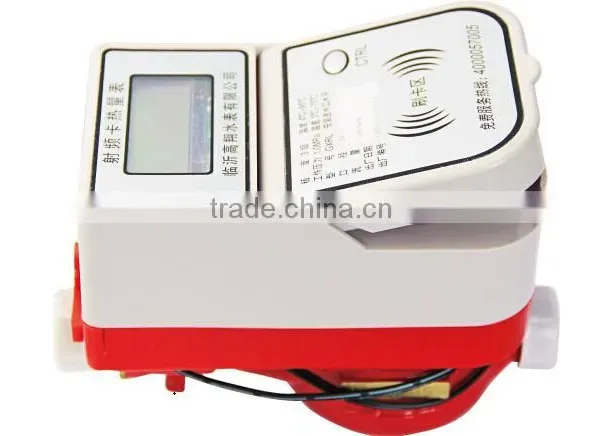
| Prepaid IC / RF card with valve control | 8-12 years; valve often fails first | Valve mechanism, seals, card reader |
| Heat meters | 5-10 years | Sensor drift, thermal cycling, local verification cycles |
Two patterns matter more than the exact numbers. Mechanical meters wear out at their moving parts; electronic meters fail at the battery or the sensor. Large-diameter meters often stay serviceable longer because the measuring element can be removed without cutting out the body. The Woltmann removable-element dry-type industrial water meter (model LXLC-250E, DN50–300mm) is one example of that design, and piston meters are covered in our guide to volumetric piston water meters.
What Kills Meters Early
How long do water meters last in the field is usually decided by the installation and the water, not the meter design.
- Water quality. Sand, grit, iron, manganese, and carbonate scale are the biggest life shorteners. Grit abrades impellers and pistons; scale changes internal clearances. A correctly sized strainer upstream is the cheapest protection available.
- Water hammer and overpressure. Rapid valve closure, pump cycling, and undersized piping send pressure spikes through the meter, cracking plastic components and stressing pistons and seals.
- Freezing. Water expands about 9% when it freezes. A frozen meter usually cracks its body or register housing. Unheated vaults, basements, and outdoor pits need insulation or a freeze plan.
- Oversizing. A meter that is too big for the actual flow spends most of its life near or below Q1, where accuracy is weakest. Size to peak flow, not pipe diameter.
- Installation errors. Wrong orientation, missing straight pipe upstream of turbine meters, debris left in new mains, and backflow all shorten life.
- Aggressive water chemistry. Low pH, high chlorides, and high dissolved oxygen attack brass and elastomers. Discuss materials with the manufacturer before specifying in aggressive water.
Accuracy Drift: The Invisible Aging
Meters rarely fail suddenly. They drift. ISO 4064, the standard most water meter approvals reference, defines four flow rates: Q1 (lowest), Q2 (transitional), Q3 (permanent), and Q4 (overload). Accuracy is specified across that range, and the low-flow end usually degrades first.
In mechanical meters, wear increases clearances and reduces the driving force on the impeller or piston, so the meter under-registers. In ultrasonic meters, fouling on the transducer face and drift in the electronics change the time-of-flight measurement. Either way, metering deviation grows and non-revenue water can grow; whether any individual meter under-registers must be confirmed by testing.
The financial effect is larger than the percentage suggests. If 10,000 meters under-register by an average of 3%, the lost revenue equals 300 meters' worth of consumption every billing cycle. That is why some utilities treat accuracy drift, not outright failure, as the replacement trigger. Field or bench testing is the only way to know where a meter actually sits.
Recalibrate or Replace? The Decision Logic
Recalibration means different things in different markets, so start with the rules. Many jurisdictions only accept meters with a valid type approval and verified calibration, and most residential mechanical meters cannot be adjusted in the field. They can only be tested and passed or rejected. Where recalibration is allowed, it usually applies to larger, serviceable meters.
- Age against expected life. Past roughly 60–70% of the expected service life — a rough planning reference, not a manufacturer specification — replacement usually wins on total cost. Base the decision on sample error tests, cumulative volume, local rules, and cost.
- Repairability. Large turbine and Woltman meters often have replaceable measuring elements; residential single-jet and multi-jet meters usually do not.
- Failure cause. A meter that failed from grit or scale will drift again in the same water.
- Regulatory deadline. If a verification or replacement deadline is already in force, that settles it.
- Upgrade path. If AMR/AMI or prepaid metering is on the roadmap, replace rather than recalibrate.
For the calibration side, including what can and cannot be adjusted, see our water meter calibration guide.
Planning Replacement Budgets Without Surprises
Replacement is predictable if you keep three records: installation date, meter model and size, and water quality history at the site.
- Set a steady annual rate. Replace a fixed percentage of the fleet each year instead of doing it in one large wave.
- Budget the whole job. Meter cost, labor, gaskets and couplings, permits or testing fees, and crew downtime. Accessories add up: brass connectors and couplings, brass check valves (MOQ 500 pcs), plastic strainers (MOQ 5,000 pcs), and IC/RF cards (MOQ 100 pcs) for prepaid systems.
- Batch orders. Standard MOQ for most Gaoxiang meters and cards is 100 pcs, and prices are negotiable based on quantity and configuration. Confirm lead time with the sales team before committing to a schedule.
- Track accuracy, not just failure. A meter that still spins is not automatically a meter that still measures.
- Combine upgrades. Pulling a meter twice costs twice as much. If pulse output, AMR, or prepaid is coming, do it during replacement.
Our water meter replacement guide covers the process step by step.
Maintenance That Actually Extends Meter Life
Most residential mechanical meters are sealed and cannot be serviced in the field, so maintenance really means maintaining the system around the meter.
- Fit and clean an upstream strainer. The highest-return action in sandy or scale-prone water.
- Size to actual flow. Check real peak and minimum flows before specifying.
- Control pressure. Check the pressure reducing valve, use slow-closing valves, and purge air after maintenance.
- Protect from freezing. Insulate vaults and above-grade installations, and manage pit drainage.
- Read the pattern, not just the total. Consumption anomalies often reveal a stuck or leaking meter first.
- Track batteries and valve cycles on electronic and prepaid meters. Those are the wear indicators to monitor.
Send Your Specification to the Manufacturer
If you are specifying replacement meters or building a multi-year replacement program, send the details: size, connection type, flow range, water quality, whether you need pulse output or AMR/AMI, and your target annual volume. Linyi Gaoxiang Water Meter Co., Ltd. is a Manufacturer & Trading Company founded in 2005 with 201-300 people, serving China, Western Europe, Southeast Asia, South America, North America, and Africa.
Per the company's official statements, all Gaoxiang water meters hold ISO 4064 regulation approval certificates, the company is ISO 9001:2008 certified, and it complies with National Regulations for testing and metrology calibration. Gaoxiang does not claim NSF certification, lead-free status, potable-water approval, or any US drinking-water approval for any model. Where those approvals are required, verify them with your own authority before specifying.
Contact Mrs. Aileen Shao, Sales manager, at +86-539-8121218 or [email protected], or write to Baishabu Town Industrial Park, Lanshan Dist., Linyi, Shandong, China. You can also use the contact page.
Frequently asked questions
How long do water meters last on average?
As a general industry range, residential mechanical meters in clean water last about 10 to 15 years, while turbine and Woltman meters in larger lines run roughly 8 to 12 years. Electronic and ultrasonic meters often target 10 to 15 years, but battery life and transducer fouling usually decide the real end of life. Local metrology rules can mandate earlier replacement.
Can a water meter be recalibrated instead of replaced?
Sometimes, but less often than buyers expect. Most residential mechanical meters must be removed and bench tested, and there is no field adjustment, so a failed unit is normally replaced. Recalibration or element replacement is more practical on large-diameter, serviceable meters where the body stays in the line. Local rules decide whether recalibration is accepted for billing.
Does water quality really shorten meter life?
Yes. Sand and grit abrade impellers and pistons, iron and manganese deposits jam moving parts, and carbonate scale changes internal clearances. Low pH and high chloride water attack brass and elastomers. In aggressive water, a meter that would last 15 years elsewhere may drift out of accuracy in five to eight years, which is why an upstream strainer and correct sizing matter so much.
How do I know when a meter needs replacing instead of waiting?
Test, do not guess. Pull a sample of meters by age group and bench-test them against ISO 4064 accuracy requirements. If a batch shows consistent under-registration at low flows, or if the fleet is past roughly 60 to 70 percent of expected service life, a rolling replacement program usually costs less than testing and reinstalling individual units.