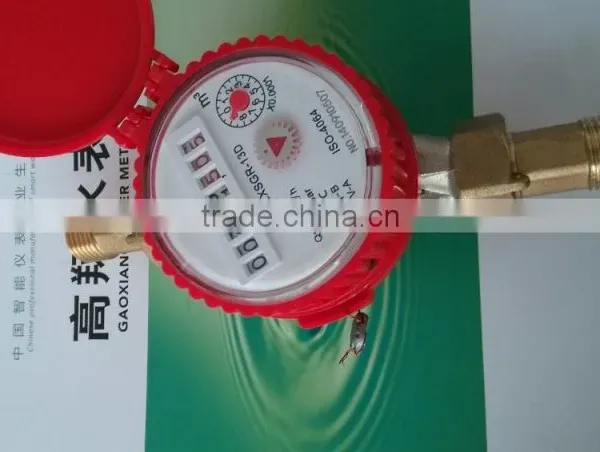
How a Single Jet Water Meter Works
A single jet water meter sends one concentrated stream of water through a nozzle onto the impeller. That single jet spins the rotor, and the movement is transferred to the register. Because the flow path is simple, single jet meters are often compact and have fewer internal parts.
They are commonly used in clean water applications with relatively stable flow. The design can be cost-effective and easy to install. However, because all flow energy hits one side of the impeller, debris, air, or uneven flow can affect performance. A strainer and correct upstream piping are important.
Typical single jet characteristics
- One nozzle directs flow onto the impeller.
- Compact body and relatively simple construction.
- Often selected for clean water and steady flow.
- More sensitive to debris and air if unprotected.
- Good fit where space and cost matter.
How a Multi Jet Water Meter Works
A multi jet water meter uses several jets around the impeller. Instead of pushing from one side, the jets distribute force more evenly. This balanced action is designed to help the impeller start reliably and run smoothly when flow rates vary. Compare the actual starting flow and Q1/R values on the data sheet rather than assuming an advantage from jet count alone.
Multi jet meters are widely used in residential and light commercial mechanical metering. They generally tolerate minor debris better than single jet designs because flow is split across multiple channels. The trade-off is a more complex internal geometry, which can affect size, pressure loss, and serviceability depending on the model.
Typical multi jet characteristics
- Multiple jets drive the impeller from different directions.
- Often better low-flow starting behavior.
- Common in residential and light commercial settings.
- More tolerant of minor debris when properly strained.
- Usually larger or more complex than single jet meters.
Single Jet vs Multi Jet: Where Each Meter Fits
Neither design is universally better. Single jet meters are often selected when water is clean, flow is consistent, and a compact, economical mechanical meter is needed. Multi jet meters are often selected when low-flow sensitivity, tolerance to minor debris, and broad residential coverage are priorities.
Buyers should also check flow range, register orientation, body material, connection type, and local metrology requirements. In larger industrial lines, a Woltmann or turbine-style meter may be more suitable than either design. For submetering, basic metering, or building distribution, the decision usually comes down to the actual flow profile and maintenance plan.
Quick comparison points
- Flow sensitivity: Check the stated starting flow and Q1 on each data sheet; multi-jet designs often target lower starting flows, while single-jet meters perform best in stable, clean flow.
- Debris tolerance: Neither type tolerates debris without strainers; check the manufacturer's water-quality requirements for the specific model.
- Size and simplicity: Single jet is often more compact; multi jet can be larger.
- Application fit: Single jet for clean, space-limited points; multi jet for residential and light commercial lines.
- Verification: Confirm the model meets local metrology and installation rules.
Selection, Installation, and Maintenance Considerations
Start with the actual flow range, not just pipe size. A meter that is too large may not register low flows reliably; one that is too small may wear faster or create unnecessary pressure loss. Follow the manufacturer's orientation, straight-pipe, and strainer requirements, because upstream disturbances can affect any mechanical meter.
Water quality also matters. Sand, scale, and air can influence impeller movement. A strainer protects the meter, but it must be sized and maintained. In hard-water or dirty-water areas, a maintenance schedule is important. For remote or prepaid systems, pulse output or remote-reading options can be considered where available, but the mechanical measuring element still determines basic metering behavior.
Gaoxiang Water Meter Co., Ltd. was founded in 2005 and operates as a manufacturer and trading company in Linyi, Shandong, China. The product range includes mechanical water meters, basic meters, prepaid water meters, heat meters, ultrasonic meters, remote reading meters, and water meter accessories. According to the company's official profile, its water meters hold ISO4064 regulation approval certificates. The company's official profile states ISO9001:2008 certification and complies with National Regulations for testing and metrology calibration.
For export orders, confirm meter type, body material, connection standard, flow range, and documents before ordering. MOQ is generally 100 pcs for most products, 500 pcs for brass check valves, and 5,000 pcs for plastic strainers. Prices are negotiable based on configuration and quantity.
When to Step Up: Woltmann and Piston Meters
Single jet and multi jet meters work well on small-to-medium lines — typically residential and light commercial service. When flows get larger, on industrial lines or mains, jet meters stop being the practical choice. That is where buyers step up to Woltmann-style meters.
A Woltmann meter handles higher, steadier flow with lower pressure loss, and its removable measuring element can be lifted out for inspection or cleaning without cutting the pipe. That matters where inspection access is limited. Note that removing the element still requires isolating and depressurizing the line first. Gaoxiang's Woltmann removable-element dry-type industrial water meter is the LXLC-250E, covering DN50–300mm.
The positive-displacement alternative
If your application needs positive-displacement measurement rather than velocity measurement, piston (volumetric) meters are the other option in the range. They measure by filling and emptying a known chamber, so they suit low flows where a jet or Woltmann meter may not start reliably.
- Small-to-medium lines: single jet or multi jet
- Higher industrial and mains flows: Woltmann, removable element
- Positive-displacement measurement: piston (volumetric)
If you are unsure which family fits, send your flow profile — minimum, normal and maximum flow, plus line size and duty — to our sales team rather than guessing from pipe size. See our water meter sizes guide for the questions to answer before you request meter pricing.
We do not claim US drinking-water certifications (such as NSF) for any model.