Why Water Meter Standards Matter to a Buyer
Standards let two meters built in different factories be compared and accepted on the same terms. For a buyer, they do three jobs.
- Acceptance. Utilities and regulators accept meters that meet the standard their rules cite. If the meter does not, it fails inspection or cannot be used for billing.
- Revenue accuracy. A water meter is a cash register. Accuracy limits at low flow decide whether small leaks and night flow get billed.
- Interchangeability. Standardized connections, dimensions, pressure ratings and pulse outputs make replacement and stocking simpler.
Standards also give a purchase order its vocabulary: flow rates, accuracy limits, pressure loss, temperature class, materials, marking and test methods.
ISO 4064: The Global Metrology Baseline
ISO 4064 is the international standard for meters measuring cold potable water and hot water in closed, full pipes. It is published in parts covering terminology, metrological and technical requirements, test methods, test report format, non-metrological requirements and installation. When a supplier says a meter is ISO 4064 approved, this family of documents is what they mean.
The part buyers need is the flow-rate vocabulary, which appears on datasheets and in tender documents.
- Q3, permanent flow rate. The highest flow at which the meter works continuously within its accuracy limits. Size on this number.
- Q4, overload flow rate. A short-term maximum, typically 1.25 times Q3. A safety margin, not a working flow.
- Q1, minimum flow rate. The lowest flow the meter must still register within its permitted error. This decides whether you capture small leaks and night flow.
- Q2, transitional flow rate. The boundary between the lower and upper accuracy zones, commonly 1.6 times Q1.
Two derived numbers matter most. The R value is Q3 divided by Q1: an R160 meter registers down to a flow 160 times smaller than its continuous rating, while R250 and R400 cover wider ranges. Wider range usually means better low-flow capture, and either higher cost or a different measuring principle. Accuracy class is the second: Class 2 is the common residential level, with permitted error of roughly ±5 percent from Q1 to Q2 and ±2 percent from Q2 to Q4 at water temperatures up to 30°C (OIML R49 allows ±3% in the upper zone above 30°C), while Class 1 is tighter. Exact limits depend on the edition cited, so check the edition your customer references.
ISO 4064 also sets pressure loss, temperature class, materials, markings and test procedures - which is what an independent laboratory actually runs. Measuring principle matters here too: mechanical water meters reach different R values depending on whether they are single-jet, multi-jet, Woltman or volumetric piston designs.
MID: What the EU Requires
MID is the Measuring Instruments Directive, 2014/32/EU. It is EU law, not a voluntary standard, and it applies to meters used for billing in EU and EEA member states. Water meters fall under Annex MI-001; heat meters and thermal energy meters under MI-004.
The point of MID is single-market access: one assessment, recognized across member states. The route normally involves type examination of the design, an approved quality system or product verification, and marking with CE plus the supplementary metrology marking and the notified body number.
The technical requirements for water meters in MID are closely aligned with OIML R49, the international recommendation for water meters. Engineers often read the two together.
Two warnings. MID approval is granted to a specific model, often within a specific size range, not to a company. And MID approval is not the same as ISO 4064 approval: ISO 4064 is the technical baseline, MID is the legal route to the marking required for billing in Europe.
Gaoxiang's stated position on its own products: all water meters hold ISO 4064 regulation approval certificates, the company is ISO 9001:2008 certified, and it complies with the National Regulations for testing and metrology calibration. No MID approval is claimed.
AWWA C700 and C701: The US Utility Standards Landscape
The United States has no single national water meter law. Metrology is largely handled at state level, and utilities write their own specifications. AWWA standards fill that gap as the de facto technical reference.
The ones buyers see most are AWWA C700 for displacement meters with a metal alloy main case (current edition) and C701 for turbine meters. Related standards cover other types: C702 compound, C703 fire service, C704 propeller, C708 multi-jet, and C715 electromagnetic and ultrasonic meters. AWWA standards are voluntary consensus standards approved by ANSI. They carry legal weight when a utility writes them into a specification or a state commission adopts them by reference, and they address construction, materials, accuracy over a defined flow range, head loss, test procedures and marking.
Expect a US specification to add local requirements on top: state weights-and-measures approval, utility-specific AMR or AMI protocols, and often NSF/ANSI 61 or 372 certification for wetted materials in contact with drinking water.
To be clear about Gaoxiang: we do not claim NSF certification, lead-free certification, potable-water approval, or any US drinking-water approval for any model. Where a US specification requires NSF/ANSI 61 or 372, we make no claim that our documents meet it — request the documents and verify them against your project requirements.
| Framework | Where it applies | Status | What it covers |
|---|---|---|---|
| ISO 4064 | International | Voluntary international standard | Metrological and technical requirements, test methods, test report format, installation |
| MID, Directive 2014/32/EU, Annex MI-001 | EU and EEA | Legal metrology requirement where national law applies (MI-001 scope) | Accuracy, conformity assessment, marking, CE |
| AWWA C700 / C701 (also C702, C703, C704, C708) | United States, utility practice | Voluntary consensus standards, adopted into specs | Construction, materials, accuracy, head loss, testing, marking |
ISO 4064 Approved vs ISO 9001 Certified: Not the Same Document
These two are often bundled together as ISO certified, which hides the difference.
- ISO 4064 is a product standard. It describes what a meter must do and how it is tested. The evidence is a type approval certificate or an accredited laboratory test report tied to a specific model and size.
- ISO 9001 is a management system standard. It describes how a factory controls quality - documentation, process control, corrective action, traceability. The evidence is a certificate for the organization, and it says nothing about the accuracy of any meter.
A factory can hold ISO 9001 and still build a meter that misses ISO 4064 accuracy limits at low flow. It can hold ISO 4064 approval for one model with no system certificate at all. Buyers building a defensible supply chain generally want both: a product approval proving the meter, and a system certificate indicating the factory can repeat it. Gaoxiang states ISO 9001:2008 certification and ISO 4064 approval certificates for all water meters.
How to Read a Certificate Claim Critically
When a supplier sends a certificate, check five things.
- Who issued it. A national metrology institute, a notified body or an accredited laboratory carries weight. A self-declared letter does not.
- Which model and size range. A certificate for DN15 does not automatically cover DN50, a different body material, or a different register.
- Which edition of the standard. ISO 4064 has been revised; a certificate against an older edition may not satisfy a spec citing the current one.
- Validity and document type. Check issue and expiry dates, and note that a type approval is stronger than a one-off test report.
- Verifiability. Ask for the certificate number so you can confirm it with the issuer. An unverifiable certificate is not useful.
Keep jurisdictions separate from standards. ISO 4064 approval confirms a model passes an internationally recognized accuracy test. It does not mean the meter is approved for billing in a particular US state, and it is not MID. Those are separate approvals against separate rulebooks. If your regulator requires an in-country approval, budget time and cost for it. More on how accuracy is demonstrated is in our guide to water meter testing and accuracy.
What to Ask Your Supplier Before You Compare Quotes
Send these questions with any quotation request and compare answers side by side.
- Which standard and which edition does this model hold approval against, and can you send the certificate?
- Which sizes, body materials and register types does that certificate cover?
- What are Q3, Q1 and the R value for each size quoted?
- What is the accuracy class, and what is the permitted error at low flow?
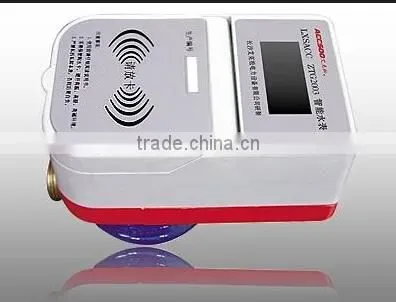
- Does the meter provide pulse output, and at what pulse factor? Is the register mechanical or electronic, including smart water meters and prepaid IC or RF card versions with valve control?
- What is the MOQ and lead time for this configuration?
Standard MOQ is 100 pcs on most meters and on IC/RF cards; brass check valves are 500 pcs and plastic strainers 5,000 pcs. Prices are negotiable, so ask for a formal quotation rather than working from a list price. Lead time depends on configuration and order volume, so confirm lead time with the sales team for your specific requirement.
Send Your Specification to the Manufacturer
If you are specifying meters for a project, the fastest route to a straight answer is to send the requirement: standard and edition, DN sizes, Q3 and R value, accuracy class, body material, connection type, register type, output and quantity. Gaoxiang's sales manager, Mrs. Aileen Shao, handles these enquiries through the contact page and can confirm which models carry ISO 4064 approval certificates, current MOQ, and lead time for your configuration.
Frequently asked questions
Is ISO 4064 approval the same as MID approval?
No. ISO 4064 is an international product standard describing accuracy and test methods. MID is EU law, Directive 2014/32/EU, governing meters used for billing in EU and EEA member states, with its own conformity assessment and CE marking. A meter can hold ISO 4064 approval without MID approval, and MID is granted per model and size, so always ask for the specific certificate.
Does an ISO 4064 certificate cover every model and size a supplier offers?
Usually not. Type approval applies to a specific design, often within a defined size range, body material and register type. A certificate for one DN15 multi-jet meter does not automatically extend to a DN50 Woltman or a different body material. Ask for the certificate naming the exact model and size you intend to buy, and check its edition and expiry date.
What does the R value mean when comparing meters?
R is permanent flow divided by minimum flow, or Q3 divided by Q1. An R160 meter must meet its accuracy requirements down to a flow 160 times smaller than its continuous rating (Q3/Q1 = 160) — this is the accuracy range, not the starting flow; R250 and R400 cover wider ranges. At the same Q3, a higher R value means a lower Q1 and therefore better low-flow performance, which matters for small leaks and night flow, but usually costs more. Always compare Q3 and Q1 together. Match the R value to the flows your installation actually sees.
Do Gaoxiang water meters carry NSF/ANSI 61 or lead-free approval?
No. We do not claim NSF certification, lead-free certification, potable-water approval, or any US drinking-water approval for any model. Our stated credentials are ISO 4064 regulation approval certificates for all water meters, ISO 9001:2008 certification, and compliance with the National Regulations for testing and metrology calibration. If a US specification requires NSF/ANSI 61 or 372, treat that as a gap to resolve before specifying our meters.