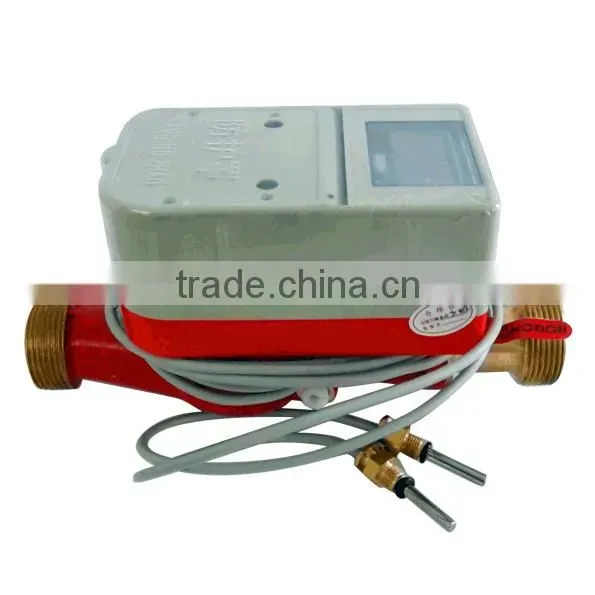
Cold vs hot water meter: the real differences
Cold and hot water meters share the same basic job: measure volume accurately. The difference is in how the materials and register handle heat. A hot water meter must maintain metrology while exposed to higher continuous temperatures and thermal cycling. That affects the measuring chamber, seals, gaskets, lens, register gears, and sometimes the body material.
| Factor | Cold water meter (general) | Hot water meter (general) |
|---|---|---|
| Temperature class | Often T30 or T50 | Usually T70, T90, or higher depending on the system |
| Seals and gaskets | Standard elastomers | Heat-resistant seals and gaskets |
| Internal parts | Standard plastics and materials | Materials selected for thermal stability |
| Register | Wet or dry dial | Dry dial often preferred to limit heat and condensation exposure |
| Accuracy risk | Lower thermal stress | Thermal expansion, seal swelling, condensation, and material fatigue |
| Typical applications | Domestic cold supply, irrigation, commercial cold water | Domestic hot water, heating circuits, hotels, industrial hot water |
Those are general differences. Always confirm the actual temperature class and materials with the manufacturer. A meter that looks correct but lacks the right temperature rating can fail early or lose accuracy.
Typical temperature classes for hot water meters
ISO 4064 uses temperature class markings such as T30, T50, T70, T90, T130, and T180. These indicate the maximum continuous temperature the meter is designed to handle. Cold water meters are often T30 or T50. Domestic hot water and heating service frequently call for T70 or T90. Higher classes appear in some industrial and district heating circuits. The class should be selected against the maximum continuous temperature and any peak excursions, not just the normal setpoint.
If the application has a recirculation loop, boiler, or solar thermal component, temperatures can spike. Record the worst-case condition and share it with the supplier. A hot water meter should be rated above the highest expected temperature, with a margin for control variation. This is general industry practice; exact Gaoxiang product ratings must be confirmed by the sales team.
Where hot water meters are used
Hot water meters appear wherever hot water is measured for billing, allocation, or process control. Common B2B applications include:
- Hotels and resorts: guest rooms, laundry, kitchens, spas, and boiler rooms.
- Multifamily and commercial buildings: domestic hot water risers and recirculation systems (flow monitoring only — recirculated volume is not end-user consumption and must not be used directly for tenant billing without confirming the metering point, return path, and billing method).
- Heating systems: hot water heating circuits, boiler make-up, and district heating interfaces.
- Industrial plants: process hot water, washing, cleaning, and food or beverage operations.
- Institutions: hospitals, schools, dormitories, and gyms with central hot water.
In some of these systems, a heat meter is used instead of, or alongside, a hot water meter. A heat meter measures thermal energy, while a hot water meter measures volume. If you need energy billing, review the heat meter product family before choosing. If you only need volume, a hot water meter rated for the temperature is the starting point.
Dry-dial advantage in hot water meter service
A dry-dial register keeps the dial and lens separated from the water path. In hot water service, that separation can reduce fogging and condensation on the lens and limit direct heat exposure to the register components. This often makes the meter easier to read in hot service. Any service-life comparison between dial types depends on materials, sealing, and operating conditions — confirm with the supplier rather than assuming a dry dial lasts longer.
Dry-dial construction is common in hot water meters, including single-jet dry-dial hot meters. However, a dry dial alone does not make a meter suitable for hot water. The body, seals, gaskets, and internal measuring parts must also be rated for the temperature. When comparing models, ask for the temperature class and material details, not only the register type.
Hot water meter selection checklist
Use this checklist before sending a request for quotation:
- Maximum continuous temperature and peak temperature. This determines the required temperature class.
- Flow range. Provide normal, minimum, and maximum flow rates. Match them to the meter's Q1, Q2, Q3, and Q4 values.
- Line size and connection type. Threaded or flanged; confirm pipe size and standards.
- Pressure and pressure loss. Confirm the system working pressure and allowable head loss.
- Water quality. Hardness, suspended solids, and chemicals can affect meter choice. A strainer upstream may be required.
- Register and communication. Manual reading, pulse output, remote reading, or prepaid valve control. Verify hot-water availability for the selected model.
- Environment. Ambient temperature, humidity, and space around the meter can affect the register and electronics.
- Approvals and local code. Check what the local authority requires. Gaoxiang states that its water meters hold ISO 4064 regulation approval certificates, is ISO 9001:2008 certified, and complies with National Regulations for testing and metrology calibration. Gaoxiang does not claim NSF, lead-free, potable-water, or any US drinking-water approval for any model. Verify requirements before purchase.
For a broader meter selection process, see our guide on how to choose a water meter.
Installation notes specific to hot lines
Hot water installation has a few extra risks: thermal expansion, condensation, and heat exposure at the register. The following practices are general and should be adapted to the manufacturer's instructions and local code.
- Install in the correct direction. Follow the flow arrow on the meter body. Reversing a meter can damage it and invalidate performance.
- Allow straight pipe runs. Follow the manufacturer's upstream and downstream requirements to avoid turbulence that affects accuracy.
- Protect the register. Avoid installing where radiant heat, steam, or high ambient temperature can exceed the meter's rating. Consider a remote register or remote-reading option if the register would be exposed.
- Manage thermal expansion. Use proper pipe supports and expansion loops. Do not use the meter to support the pipe.
- Use compatible gaskets and seals. Hot water can degrade standard cold-water gaskets. Confirm materials with the supplier.
- Flush the line before installation. Debris can block the measuring element. A strainer upstream helps protect the meter.
For step-by-step mechanical guidance, see our water meter installation guide.
Common mistakes buyers make
One common mistake is choosing a cold water meter for a hot line because it is cheaper or in stock. That can lead to seal failure, inaccurate readings, and leaks. Another is selecting a meter only by pipe size. A DN20 hot water meter from one series may have a very different flow range and temperature rating from another. Buyers should also confirm whether the application needs volume measurement or energy measurement, and whether remote reading or prepaid control is required.
Finally, do not assume that a certificate for one model applies to every model. Ask for the specific documentation needed by your utility or project, and review the temperature class, materials, and accuracy class for the exact product. Prices are negotiable, and MOQ is typically 100 pcs for most meters and cards; confirm details with the sales team.
Send your hot water meter specification to the manufacturer
If you are sourcing a hot water meter for distribution, a hotel project, a heating system, or an industrial account, send the specification to Gaoxiang Water Meter. Include line size, flow range, maximum temperature, pressure, connection type, register or communication requirement, and target quantity. The sales team can confirm the suitable model, MOQ, lead time, and current pricing. Contact Mrs. Aileen Shao, Sales manager, at +86-539-8121218 or [email protected], or use the contact page.
Frequently asked questions
Can I use a cold water meter on a hot water line?
No, not unless the meter is explicitly rated for the temperature and pressure. Cold water meters may use seals, plastics, and register components that are not designed for hot service. Heat can cause leaks, condensation, inaccurate readings, and early failure. Always choose a hot water meter with a temperature class at or above the maximum continuous temperature, and confirm materials with the supplier.
What temperature class do I need for a hot water meter?
Determine the maximum continuous temperature and any peak temperatures first. ISO 4064 temperature classes include T30, T50, T70, T90, T130, and T180. Domestic hot water and heating systems often fall in the T70 to T90 range, while some industrial or district heating applications need higher classes. Select a class above your worst-case temperature and confirm the exact rating with the manufacturer.
Is a dry-dial hot water meter better than a wet-dial meter?
A dry-dial register keeps the dial separate from the water, which can reduce fogging and condensation and limit heat exposure to the register. That is why dry-dial construction is common in hot water meters, including single-jet dry-dial hot meters. However, the whole meter must be rated for hot water. Check the body, seals, gaskets, and internal materials as well as the register type.
Does Gaoxiang offer NSF or potable-water approval for hot water meters?
Gaoxiang states that its water meters hold ISO 4064 regulation approval certificates, is ISO 9001:2008 certified, and complies with National Regulations for testing and metrology calibration. Gaoxiang does not claim NSF, lead-free, potable-water, or any US drinking-water approval for any model. Buyers should verify local code, utility, and project approval requirements before ordering, and request the specific documentation needed.