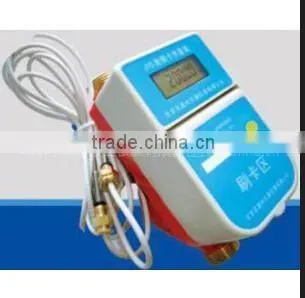
The Four Remote-Reading Paths at a Glance
Every remote-reading architecture is a chain: the meter, the communication link, the network, and the head-end software that turns readings into bills or dashboards. The four paths below differ mainly in who owns the middle of that chain, and who pays for it.
| Path | Topology | Device power | Coverage | Best fit | Main constraint |
|---|---|---|---|---|---|
| LoRaWAN | Meter to gateway to network server | Battery, duty-cycled uplinks | Set by gateway placement | Campus, utility cluster, industrial park with a gateway site | You own and maintain the gateway and its backhaul (private LoRaWAN network; third-party network services are a separate option) |
| NB-IoT | Meter direct to licensed cellular network | Battery, optimized for periodic uplink | Where the carrier provides service | Scattered meters, urban rollouts, no gateway site | Subscription cost, carrier dependence, deep-basement gaps |
| M-Bus / RS485 | Wired bus to a concentrator or master | Bus-powered or locally powered | Limited by cable run | Buildings, riser stacks, plant rooms, dense meter banks | Cable, conduit, and retrofit labor |
| Pulse output | Dry-contact pulses to a third-party logger or RTU | Depends on the logger | Depends on the logger network | Retrofits into existing SCADA, BMS, or AMR | No meter diagnostics; miscounting if not configured correctly |
Two points are easy to miss. Only two of these four paths are genuinely wireless at the meter: M-Bus is a cable, and pulse output is just a signal that still needs a logger to transmit anything. Also, the meter is often the smaller half of the project cost once gateways, loggers, and software are counted.
LoRaWAN: You Build the Network, You Own the Coverage
LoRaWAN is an open specification built on unlicensed sub-GHz radio bands, which in North America means the 902-928 MHz region and in Europe the 868 MHz band. Meters transmit short payloads to one or more gateways, and the gateway forwards them to a network server over an IP backhaul. Range is not a fixed number: it depends on terrain, building density, antenna height, and gateway siting. Open suburban or rural conditions allow several kilometers per gateway, while dense urban sites and below-grade meter pits can cut that sharply.
Because gateways can serve many endpoints, LoRaWAN gets cheaper per meter as density rises. Battery life is normally managed by duty cycling and device class - Class A devices listen only briefly after transmitting, while Class C devices listen almost continuously and draw far more power. If remote valve control matters, ask how downlink commands are handled, because a short downlink window limits how quickly a valve command can be delivered.
What you take on: gateway procurement, mounting, power, backhaul, and coverage testing. LoRaWAN is a poor fit if nobody wants to own that infrastructure.
NB-IoT: Cellular Coverage With an Ongoing Subscription
NB-IoT runs in licensed cellular spectrum and is managed by the mobile operator, so there is no gateway to buy or site. The meter registers with the network like a phone, and data reaches your server through the carrier platform or a cloud endpoint. It suits projects where meters are geographically scattered or where no gateway location is available.
Power behavior is built around long sleep periods and periodic reporting, which is a reasonable match for a water meter sending daily or hourly readings. Coverage is the common assumption to test rather than trust: above-ground meters in urban areas usually behave well, but deep basements, concrete vaults, and metal enclosures can be problematic. Plan a pilot installation in the hardest location on the site before committing to a full rollout.
What you take on: a per-device connectivity subscription for the life of the meter, dependence on one carrier's coverage and platform, and exposure to technology lifecycle decisions made by that carrier. On the plus side, no radio infrastructure is yours to maintain.
M-Bus and RS485: Wired Reliability Where Cable Is Practical
M-Bus is the conventional wired bus for utility meters in buildings and district heating. A two-wire bus carries both data and power to the meters, and a master or concentrator collects readings and forwards them over Ethernet or cellular. RS485 is the more general industrial option, usually carrying Modbus RTU, but it does not power the meters, so each device needs its own supply.
Wired reading has real advantages. There are no radio coverage questions, no battery replacement cycle for the communication path, and no per-device subscription. For a single building with a riser stack, a plant room, or a bank of apartment meters, cabling is often the most durable answer.
The constraint is physical: someone has to pull the cable. In new construction that is easy budget; in a finished building it can be the dominant cost. Bus length, device count per segment, and termination all need engineering, not guesswork.
Pulse Output: The Simplest Integration, and the Easiest to Get Wrong
A pulse-output meter emits a dry contact or transistor pulse each time a set volume passes through it. Our catalog lists a Pulse Transmitting Pulse Output Water Meter LXS15-300 with 1, 10, or 100 liter per pulse options. The meter itself is not wireless - it hands a signal to a logger, RTU, PLC, or building management system that already exists, and that device owns the network.
This is usually the lowest-cost way to bring an existing mechanical meter into a remote-reading system, and it is the easiest path when your SCADA or billing platform already accepts pulse inputs. It also works with water, heat, and many other utility meters with the same input hardware.
The risks are integration risks, not radio risks: missed pulses when the counting input cannot keep up at high flow, bounce on long cable runs, unclear pulse constants, and no meter diagnostics or device identity on the wire. Confirm the pulse constant and the maximum pulse frequency the meter can produce, and match both to your logger's input specification.
Decision Matrix by Project Type
Use the project shape to cut the list down, then confirm details with the supplier.
- Utility-wide rollout, no gateway sites: NB-IoT is the usual starting point because coverage is the carrier's problem. LoRaWAN becomes competitive if the utility is willing to build and own a gateway network.
- Single campus or industrial park, fiber or power available for a gateway: LoRaWAN, with one or two gateways covering hundreds of endpoints.
- One building, riser stack, apartments or offices: M-Bus or RS485. Wired reading can be cheaper to operate over a 10 to 15 year horizon than battery-powered radios, depending on wiring, battery replacement, communication, and maintenance costs.
- District heating or heat metering: M-Bus is the mainstream choice and keeps heat and water meters on one reading bus.
- Plant or factory with existing SCADA or PLC: pulse output or RS485 straight into the control system you already run.
- Mixed portfolio of existing meters: retrofit pulse output where the meter supports it, and standardize the logger and head-end first.
- Prepaid or tenant billing: card and smart prepaid meters with valve control are a separate architecture choice; see IC vs RF prepaid before mixing it into this comparison.
Whatever you choose, make sure your head-end understands the difference between automated meter reading and full two-way network management. That distinction is covered in AMR vs AMI explained.
What to Confirm With the Meter Supplier
Radio choice is a system decision, so the supplier conversation should be about interfaces and documents, not adjectives. Ask for these specifics in writing:
- Output type per model: pulse output, wired M-Bus or RS485, or an integrated radio module, and whether the radio is factory-fitted or an add-on.
- Pulse constant and maximum pulse frequency, if pulse output is used.
- Regional radio variant: 902-928 MHz and FCC-related approvals for North America, 868 MHz for Europe, and which carrier bands for NB-IoT.
- Payload and protocol documentation detailed enough for your integrator to build against, plus whether the device joins a standard network server or requires a vendor platform.
- Downlink support, if remote valve control is required, and what that does to battery life.
- Battery type, expected service interval, and how the battery is replaced in the field.
- Minimum order quantity and lead time - confirm lead time with the sales team, as it varies by model and configuration.
On approvals, be precise. Gaoxiang states that all of its water meters hold ISO 4064 regulation approval certificates, that the company is ISO 9001:2008 certified, and that it complies with National Regulations for testing and metrology calibration. These are the manufacturer's own statements. No NSF certification, lead-free claim, potable-water approval, or other US drinking-water approval is claimed for any model. If your project requires those, verify them separately before you order.
Send Your Specification and Get a Straight Answer
If you already know your pipe sizes, flow range, reading interval, and whether you want battery radio or wired bus, send that specification through the contact page. A concrete brief - meter count, location types, head-end software, and approval requirements - gets you a specific answer instead of a brochure.
Frequently asked questions
Is LoRaWAN or NB-IoT better for a utility-wide rollout?
It depends on who owns the network. If the utility will not build and maintain gateways, NB-IoT is usually simpler because the carrier handles coverage. If the utility has suitable sites, backhaul, and staff to run gateways, LoRaWAN can be cheaper per meter at scale and keeps the data path under your control. Many utilities operate both.
Do I have to buy and maintain a gateway?
With NB-IoT, no - the carrier operates the network and you pay for connectivity per device. With LoRaWAN, yes, unless a third party provides the network. Gateways need mounting, power, and an IP backhaul, plus periodic coverage checks. That ongoing responsibility is the main hidden cost of LoRaWAN in small projects.
Can I add remote reading to mechanical meters already installed?
Only if the meter has a pulse output or can be fitted with one. A pulse-output meter feeds a logger you install nearby, which then transmits. If your existing meters have no pulse output and cannot be retrofitted, replacement with a pulse or smart meter is the alternative. Confirm the pulse constant before buying loggers.
How do I know the meter will work with my billing or SCADA software?
Ask for the payload and protocol documentation before ordering, not after. You need to know whether the device sends a standard protocol, what the register values mean, and how configuration is applied. Test one or two units on your own system first. A pilot device is cheaper than debugging a full shipment in the field.